
How to Scale Beyond Amazon Without Losing Control of Your Operations
.png)
How to Scale Beyond Amazon Without Losing Control of Your Operations
Amazon helped you grow. Now you’re ready for more.
You’ve expanded into Shopify, Walmart, or other channels, and revenue is climbing. On paper, everything looks strong. But behind the scenes, your team is juggling inventory spreadsheets, chasing late shipments, and double-checking numbers that never seem to match.
What worked when Amazon was your primary channel starts to break once you move beyond it.
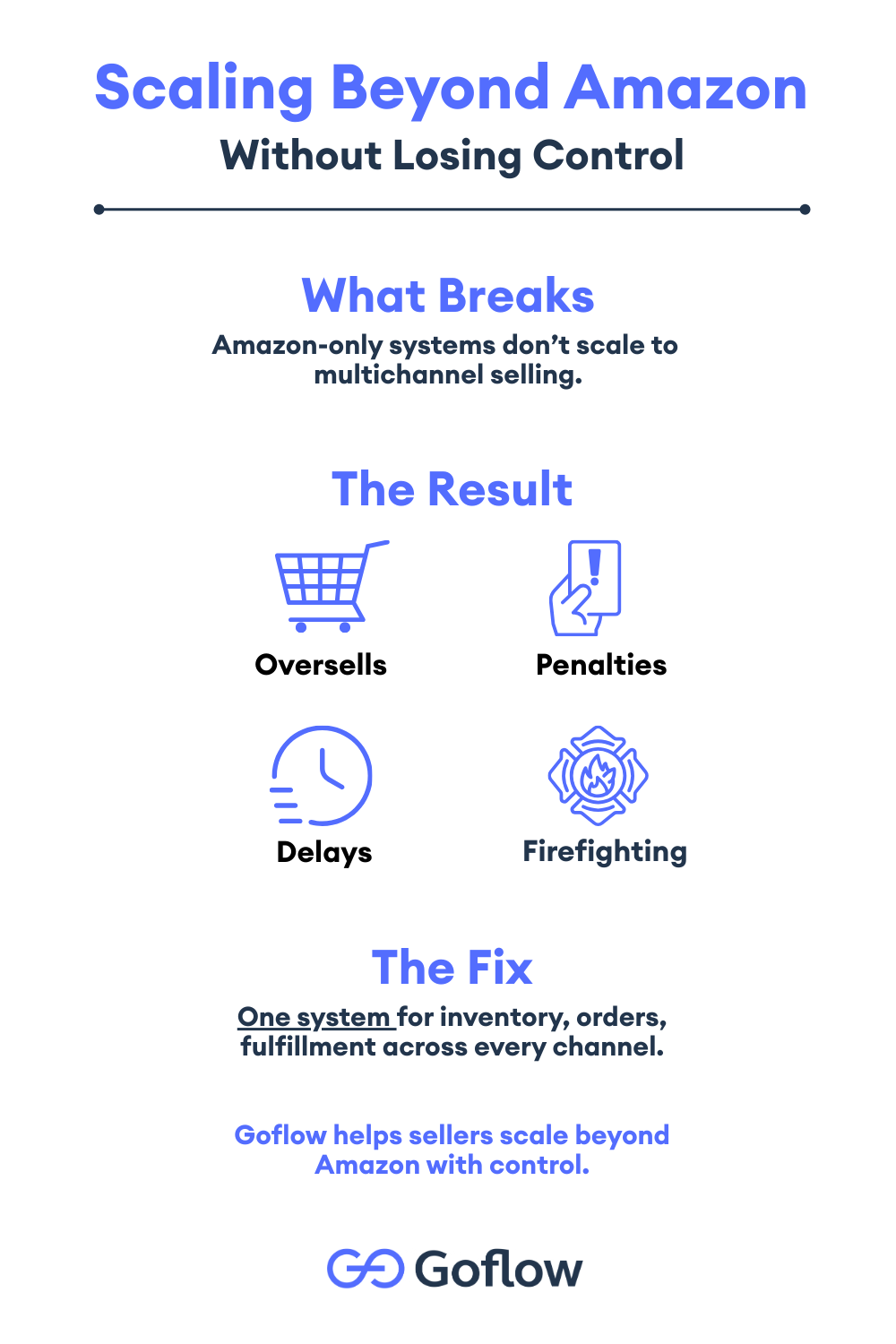
Amazon-centric operations aren’t built for multichannel reality. As soon as orders start flowing in from multiple places, cracks appear fast. Inventory gets oversold, fulfillment rules collide, and teams spend their days reacting instead of planning.
Growth beyond Amazon is the goal. Losing control doesn’t have to be the cost.
In this post, we’ll share practical ways ecommerce sellers can expand beyond Amazon while keeping their operations stable, predictable, and under control.
Why Scaling Beyond Amazon Exposes Operational Gaps
Amazon simplifies a lot early on. FBA handles fulfillment. Inventory lives mostly in one ecosystem. Rules are clear, even if they’re strict.
But once you expand beyond Amazon, that simplicity disappears.
Every new channel adds:
New inventory commitments
New fulfillment rules
New data flows
New ways for things to go wrong
Common breaking points sellers hit when scaling beyond Amazon include:
Struggling to allocate inventory between FBA, FBM, Shopify, Walmart, and other channels
Manual processes that worked on Amazon but collapse at higher volume
Teams stuck firefighting instead of planning inventory and growth
No real-time visibility into what can actually be sold right now vs. what’s already committed
Mis-picks, mis-shipments, and missed steps increasing with order volume
More chargebacks, compliance issues, and seller performance hits
Growth beyond Amazon doesn’t create these problems. It exposes systems that were never designed for multichannel scale.
If you want to expand sustainably, you need visibility and control across every channel you sell on—not just Amazon.
 How to Scale Beyond Amazon Without Losing Control
Scaling doesn’t mean slowing down. It means removing friction so growth stays manageable.
At a certain point, expanding beyond Amazon stops being a marketing challenge and becomes an operational one. Sellers who scale smoothly aren’t working harder. They’re operating inside systems built for multichannel volume.
With the right foundation, you gain:
Real-time visibility into inventory and orders
Predictable workflows instead of constant fire drills
Systems that scale as order volume and channel mix increase
Here are the essentials for growing beyond Amazon without losing control:
Centralize Your Inventory View
When Amazon is your main channel, inventory decisions are simpler. Once you expand, inventory spreads everywhere—and that’s where trouble starts.
The problem isn’t having inventory in multiple places. The problem is not having one accurate view of how that inventory is allocated.
Your inventory system should reflect stock across:
Amazon (FBA and FBM)
3PLs
Other sales channels
Multiple warehouses
Why this matters:
Better forecasting and replenishment
Fewer stockouts and last-minute surprises
More confidence allocating inventory across channels
Without centralized visibility, sellers either oversell the same inventory twice or leave sellable stock sitting unused. A unified view lets teams make clear decisions instead of reacting under pressure.
For a deeper look at this, check out: Why Every Serious Ecommerce Brand Needs a Multichannel Operating System to Scale.
Clarify “Sellable vs. Available” Inventory
One of the most common mistakes sellers make when moving beyond Amazon is assuming total inventory equals sellable inventory.
In reality, inventory is often tied up in:
Pending orders
Inbound shipments
Damaged or quarantined stock
Channel-specific commitments
This lack of clarity creates cross-channel fallout. One channel oversells, and suddenly every channel feels the impact—stockouts, delayed shipments, and frustrated customers.
To scale safely beyond Amazon, you need to know what’s truly sellable right now, not just what exists in total.
A Multichannel Operating System (MCOS) like Goflow gives real-time visibility into what’s sellable, committed, and at risk, so you can grow without guessing.
Align Listings and Inventory Across Channels
As order volume increases, small listing and inventory mismatches quickly turn into big problems.
Sellers need confidence that when something sells on one channel, inventory is accurately reflected everywhere else.
With Goflow, sellers align listings and inventory in a way that supports growth instead of creating risk. The result:
More accurate inventory availability across channels
Fewer fulfillment mistakes as volume increases
Less manual checking and second-guessing
This alignment creates a reliable operational backbone. As orders accelerate beyond Amazon, systems stay steady instead of chaotic.
Maintain Fulfillment Control Across Channels
Fulfillment becomes significantly more complex once you move beyond Amazon.
Different channels bring different rules, service-level expectations, carriers, and shipping requirements. Managing each channel in isolation quickly breaks down at scale.
The goal isn’t to optimize Amazon, Shopify, or Walmart separately. It’s to create consistent, reliable fulfillment workflows that work everywhere you sell.
With Goflow, sellers manage shipping and fulfillment from one system, helping ensure:
The right shipping methods are used based on rules, cost, and service level
Rates can be compared across carriers where applicable
Labels and tracking are generated accurately and automatically
Fulfillment steps stay consistent as volume increases
Amazon Buy Shipping is one example of how Goflow supports channel-specific requirements while keeping fulfillment centralized and controlled. The result is fewer mistakes and a fulfillment operation that scales beyond Amazon without fragmenting.
Automate as Much As You Can
Manual work becomes a liability as soon as you scale beyond Amazon.
Every extra human touch increases error risk. And in a multichannel operation, one mistake rarely stays contained. A missed update on one channel can ripple across inventory, fulfillment, and customer experience everywhere.
Automation reduces workload and risk by creating consistent, repeatable processes.
Key areas to automate:
Order imports
Inventory updates
Document and data flows
Automation also enables proactive alerts for:
Low stock levels
Missed fulfillment steps
Time-sensitive shipments
Automation doesn’t just save time. It prevents small issues from turning into multichannel failures.
For a deeper dive into how automation can help you scale, check out this blog post: Work Smarter, Not Harder: The Power of Automation for Inventory Management.
Goflow Helps Sellers Scale Beyond Amazon the Smart Way
Scaling beyond Amazon requires more than patches and point solutions. It requires an operational foundation built for multichannel growth.
As sellers expand into Shopify, Walmart, and other channels, complexity increases fast. Inventory, orders, fulfillment, and data all need to stay aligned—without forcing teams to manage each channel in isolation.
A Multichannel Operating System like Goflow is designed for sellers who want growth and control as they expand beyond Amazon.
Key benefits:
Centralized inventory and order management across all channels
Automated document and data flows between systems
Clean, structured data that scales with volume
What sellers actually care about:
Faster, more predictable fulfillment
Fewer errors, chargebacks, and performance issues
Confidence as channel mix and order volume grow
Instead of juggling disconnected tools for each marketplace, sellers operate inside one system designed to scale beyond Amazon without adding operational overhead.
Growth Beyond Amazon Can Be Strategic and Controlled
Expanding beyond Amazon is exciting—but it’s only sustainable with the right operational foundation.
The most successful sellers build systems for their next stage of growth, not just their current volume. They add channels, SKUs, and fulfillment locations without having to rebuild operations every time.
Too many sellers patch things together to survive today, then pay the price at the next milestone.
A Multichannel Operating System allows you to:
Handle more SKUs
Process more orders
Expand into more channels
Manage additional fulfillment locations
With the right systems in place, you can scale beyond Amazon with clarity, confidence, and control.
Ready to grow without the chaos?
Schedule a demo to learn how Goflow helps ecommerce sellers achieve repeatable, predictable growth across all the channels they sell on.
Ready to get started? Join Goflow for free and start scaling today.