
Why Every Serious Ecommerce Brand Needs a Multichannel Operating System to Scale
.png)
Eventually, every successful ecommerce operator reaches a tipping point.
Maybe you’ve expanded into Amazon, Shopify, Walmart, or even eBay or TikTok Shop. You’ve added more SKUs. More warehouses. More volume. More moving parts.
Suddenly, the system that got you here can’t carry you any further.
You start to feel the strain:
Your listings are inconsistent across channels.
Stockouts result in angry customers, forcing customer service into apology mode.
Your warehouse is scrambling because no one has reliable visibility.
Your team is spending too much time fixing preventable issues.
This is the moment when you realize that you just can’t scale a multichannel operation using spreadsheets, disconnected tools, and duct-taped workflows.
The only sustainable way to grow your business is by using a multichannel operating system, so you can get perpetual, real-time insights into your entire operation, from listings to inventory to fulfillment.
In this blog post, we’ll cover why a multichannel operating system is so important, how it will transform your business, and how you can tell if you’re ready to make the switch.
What is a Multichannel Operating System (MCOS)?
A Multichannel Operating System is a centralized platform that unifies listings, inventory, orders, fulfillment, and data across every marketplace and warehouse, giving operators one real-time system to run their entire ecommerce business.
It’s built to eliminate disconnected tools, prevent overselling, automate workflows, and give teams one source of truth from listing creation to final delivery.
What a Multichannel Operating System Is Not
To avoid any confusion, let’s be clear about what an MCOS is not.
Not a spreadsheet (even if it’s color-coded and beautiful)
Not a tool stack patched together
Not just an OMS
Not just a WMS
Not just a listing tool
An MCOS replaces the entire patchwork, not just a few pieces of it.
Why Multichannel Sellers Break Without One
The more you scale your brand, the faster the cracks start to appear in your operations. What worked fine at five orders per day starts to break down at fifty or more. As your business grows, it becomes impossible to keep up without a unified system.
Inventory Becomes Unmanageable
Inventory problems escalate fast. Sync delays trigger overselling, dead stock builds up, and teams waste hours reconciling numbers because there’s no single source of truth. What should be predictable becomes chaotic.
Listings Multiply Out of Control
As product catalogs grow, the workload grows exponentially. A single product update must be repeated across every channel, which invites errors, inconsistencies, and off-brand listings.
Fulfillment Gets Messy
When orders start flowing in from multiple channels, fulfillment becomes a guessing game. Wrong warehouse assignments, outdated stock counts, and delayed routing lead to late shipments and, ultimately, unhappy customers.
Teams End Up Working in Silos
Different teams rely on various tools, dashboards, or exports, meaning no one is looking at the same reality. Customer service sees one inventory count, operations sees another, and marketplace managers operate independently. The result is friction, misalignment, and constant firefighting.
Data Gets Fragmented
To get accurate financials, you have to piece together various exports. There’s no clear view of true demand, profitability, or channel performance. Without a unified system, there’s no insight into how your operations are going.
Growing without infrastructure is like adding lanes to a highway without reinforcing the foundation underneath; eventually, everything collapses under its own weight.
We’ve seen this happen many times before. For example, a fast‑growing ecommerce brand expands beyond its original sales channel and begins listing products on Shopify, Walmart, Amazon, and TikTok Shop. At first, it feels like a natural step forward, until the issues start to pile up.
Inventory data ends up scattered across multiple spreadsheets, creating sync delays that lead to overselling and surprise stockouts. A simple product update has to be made separately in every backend, and orders start routing incorrectly because no one has a real‑time view of what’s in stock where. And when it’s time to reconcile financials, leaders realize their data is stitched together from mismatched reports.
By that point, the operational friction is already eroding growth. The brand isn’t struggling because demand is low, it’s struggling because the infrastructure beneath the growth can’t keep up.
What a Multichannel Operating System Should Give You
What really matters is not features for the sake of features, but the business outcomes that a smart, fully-integrated system can offer you. Look for the following capabilities when choosing an MCOS, as they will help to remove obstacles that slow growth, burn hours, or create costly errors.
Real-Time Inventory as Your Single Source of Truth
A MCOS keeps every SKU and stock level synced instantly across all of your channels, from Amazon to Walmart to Shopify, eBay, TikTok, and every warehouse you use. That means you’ll never have to worry about overselling, guessing, or reconciling spreadsheets. You’ll always know exactly what inventory you have, where it is, and how fast it’s moving, giving you the control you need to scale confidently.
Unified Listings Across Every Marketplace
Imagine being able to update a listing once and publish it everywhere, instead of having to update it manually across ten different backends. This will help improve your brand consistency, and it will save you hours of work every week. You’ll be able to keep your catalog tight, your content accurate, and your marketplace presence polished, without becoming overwhelmed as you scale.
Smart Order Routing
Another feature to look for in a multichannel operating system is automated smart order-routing, which routes orders to the fastest, most cost-efficient fulfillment option. You’ll save on fees, prevent late shipments, and protect your seller ratings and buy boxes.
A small e-commerce brand saw 10% sales growth and saved what had been a “full day” previously spent on manual inventory management when they switched to automating their order fulfillment.
Automated Workflows
Instead of spending your day clicking through repetitive tasks, automation can handle routing, tagging, bundling, and exceptions for you. This will free you up to focus on higher-value work, like scaling channels, launching new products, or improving your margins.
According to Shopify, 3,633 businesses collectively offloaded 1.1 billion decisions and reclaimed an estimated 9.2 million hours of work over two years with automation.
Proactive Exception Management
With smart exception management built right into your system, issues like missing attributes, low stock, or unfillable orders will be flagged instantly, before they become a problem for your customers. Instead of reacting to problems, your team will stay ahead of them and prevent negative reviews or failed SLAs.
Reporting That Actually Helps You Operate
Forecasting, demand trends, profitability by channel, and operational performance metrics all live in one place. You can make decisions based on clear, real-time data instead of hunches or stitched-together exports.
One Clean Dashboard for Everything
With every channel, order, warehouse, and workflow in one unified view, operators make faster decisions with less mental load, no more juggling tabs or piecing together the truth.
Goflow offers all of the above, as it’s built specifically for multichannel ecommerce operators who want full control, clean data, and stable operations at scale. When operators finally gain full control over their workflows and data, everything accelerates. Decisions get faster, mental load drops, and revenue and margin improve as a direct result.
Scaling With vs. Without a Multichannel Operating System
It’s the difference between barely keeping up and running a tight, successful, scalable operation.
Without an MCOS | With an MCOS like Goflow |
Higher risk of overselling | Inventory syncs instantly |
Warehouse frequently picks the wrong SKUs | Orders auto-routed to the optimal fulfillment location |
Listings are inconsistent across marketplaces | Listings managed all in one place |
Customer service is overwhelmed | Warehouse and customer service are fully aligned |
You’re always spending your days cleaning up yesterday’s mistakes | You can work proactively, rather than reactively |
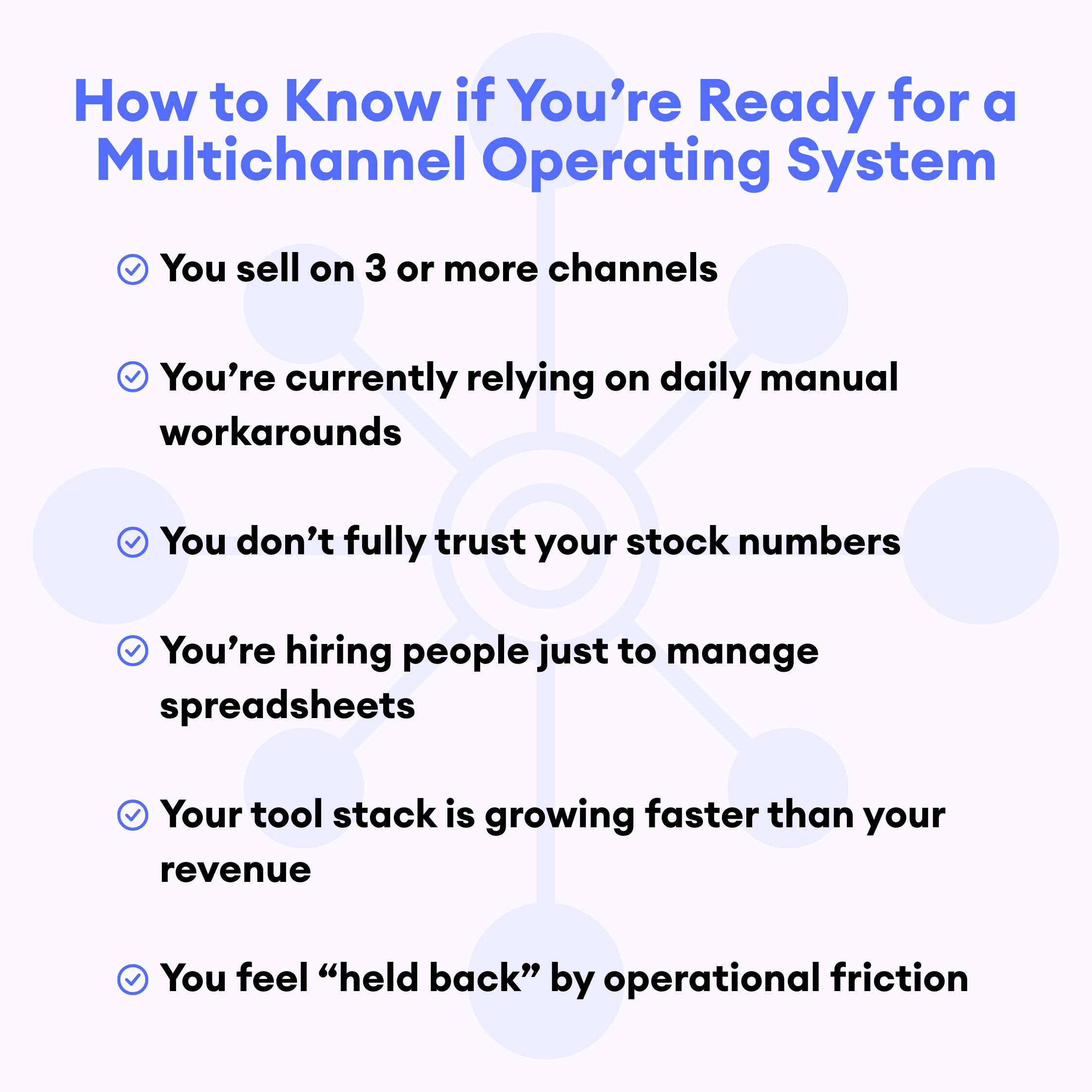
How to Know If You’re Ready for a Multichannel Operating System
If any of these sound familiar, you’re already at the tipping point:
You sell on 3 or more channels
You’re currently relying on daily manual workarounds
You don’t fully trust your stock numbers
You’re hiring people just to manage spreadsheets
Your tools stack is growing faster than your revenue
You feel “held back” by operational friction
If you nodded along to two or more while reading that list, you’re ready!
 The Bottom Line: Scaling Requires the Right Infrastructure
Growth and chaos will continue to scale together unless you put the right operational backbone in place. Multichannel success isn’t about more people or more tools. It’s about one system that unifies everything.
Goflow is built to be that system for serious ecommerce operators, giving them the clarity, control, and stability they need to run with confidence.
Ready to get ahead of the chaos? See how Goflow connects your channels, warehouses, and workflows into one clean operating system, so you can scale without losing control.