
AI-Ready Data for Multichannel Ecommerce: What to Fix First

Our recent guest post on building an operational data layer showed what happens when a multichannel seller connects Goflow and marketplace data to an AI assistant: questions about margin, stockouts, and reorders get answered in plain English instead of a four-CSV afternoon. It rests on one assumption. The answers are only as good as the records underneath them, which is why AI-ready data comes first.
An AI model will not tell you that half your Walmart listings point to a retired SKU, or that a third of your catalog still carries 2024 freight costs. It will calculate margin anyway, confidently, and hand you a number that looks precise. Wrong inputs do not produce error messages. They produce plausible answers.
This piece is the companion. It covers what AI-ready data means across Amazon, Walmart, Shopify, and wholesale, a five-point audit to find the gaps, what they cost, and a 30-day plan to close them.
What AI-ready data means for multichannel sellers
AI-ready data is operational data an AI model can use without guessing: every product has one identity, every cost is current, every status means the same thing on every channel, and every business rule is written down. Gartner found in 2025 that 63% of organizations either lack or are unsure they have the right data management practices for AI.
For a multichannel seller, AI-ready data gets specific fast. The SKU that sells as a two-pack on Amazon, a single unit on Shopify, and a case of 12 to a wholesale buyer has to resolve to the same product, with inventory and cost that roll up correctly. A return marked "refunded" on Walmart and "closed" in your warehouse system has to be understood as the same event, or as different events, on purpose.
Why a data layer can't fix bad inputs
A data layer is plumbing. It moves, joins, and pre-calculates records so an AI model can read them efficiently. It does not decide whether those records are right. The same Gartner release predicts that through 2026, organizations will abandon 60% of AI projects unsupported by AI-ready data. That prediction is not about weak models. It is about weak inputs.
Where ecommerce data breaks without anyone noticing
Multichannel data drifts. A listing gets duplicated during a marketplace category change. A vendor raises prices, and the new cost lands on the purchase order but never on the product record. A gift set gets created on Shopify as its own SKU instead of as a kit of two components. Each gap is small. An AI model joins thousands of them in a single query.
The 5-Point AI-Ready Data Audit
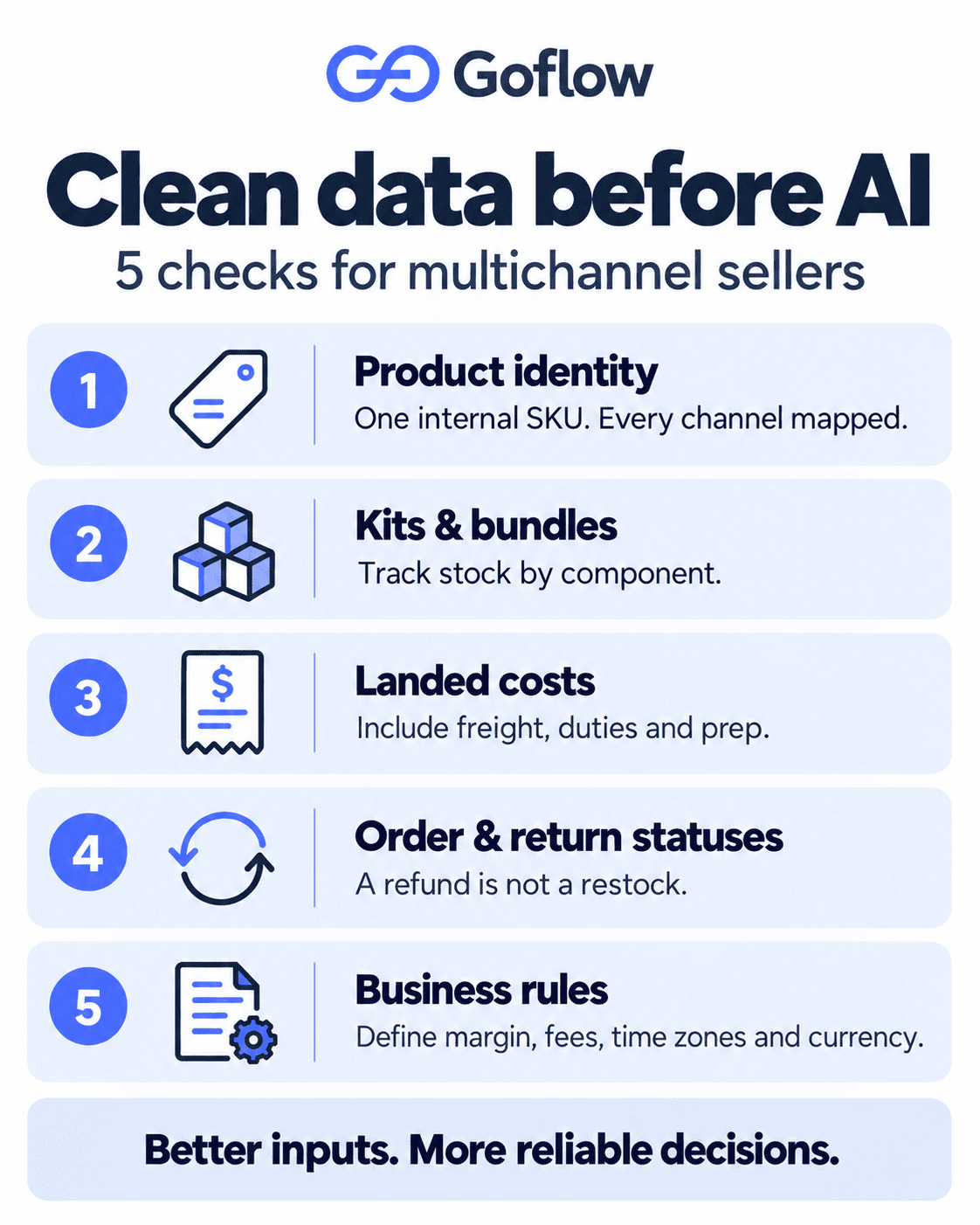
The 5-Point AI-Ready Data Audit checks the five records an AI model touches in almost every operational question: product identity, product composition, landed cost, order and return status, and written business rules. IBM's 2025 CEO Study found 72% of CEOs see their proprietary data as key to unlocking generative AI's value. For a seller, these five records are that proprietary data.
Check | What AI-ready data looks like | Common failure | Wrong answer it produces |
|---|---|---|---|
1. Identity | One internal SKU per sellable product, with every channel listing mapped to it | Duplicate or orphaned listings; FBA and merchant SKUs tracked separately | Sales split across "two products," understated velocity, missed reorders |
2. Composition | Kits, bundles, and multipacks defined by their components | Bundles created as standalone SKUs with their own stock count | Phantom inventory, wrong cost per order, oversold components |
3. Cost | Landed cost on every SKU, updated from received purchase orders | Unit cost frozen at the first PO; freight and duties missing | Margin overstated on exactly the SKUs with rising costs |
4. Status | Order, cancellation, and return states mean the same thing on every channel | Returns refunded on the channel but never received or dispositioned | Revenue and stock counts that never reconcile |
5. Rules | Margin, fee attribution, time zone, and currency defined in writing | Every spreadsheet uses its own formula | Three "correct" answers to the same question |
The 5-Point AI-Ready Data Audit: each check maps to a record AI touches in nearly every margin, inventory, or reorder question. A failure in any row produces answers that look precise and are wrong.
1. Identity: one SKU, one product
Start with listing-to-SKU mapping, the foundation of AI-ready data. Pull every active listing from every channel and confirm each one points to exactly one internal SKU. Look for Amazon FBA and merchant-fulfilled versions of the same item, variation children relisted after a suppression, and wholesale item numbers that were never linked. If a product lives under two identities, an AI model will report it as two products with half the velocity each.
2. Composition: kits built from components
A bundle sold as its own SKU with its own stock count is a guess about inventory. Define kits by their components, so selling one gift set deducts one candle and one diffuser, and the cost of the set is the sum of its parts. This check most often explains why an AI says you have 400 sellable units while the warehouse has 150.
3. Cost: landed cost that stays current
Margin is the question operators ask AI most, and AI-ready data for margin starts with cost. Every SKU needs a landed cost that includes unit price, inbound freight, duties, and prep. That cost should update when a new purchase order is received, not sit at whatever someone entered at launch. Date-stamp it, so a question about last quarter uses last quarter's cost.
4. Status: one meaning for every order and return state
Channels describe the same event in different words. Decide what "cancelled," "partially shipped," "refunded," and "returned" mean in your own system, then map every channel's statuses to those definitions. Returns need extra attention, because returns are an inventory problem before they are a finance one. A refund issued on the marketplace and an item received, inspected, and restocked are separate events, and only one of them changes sellable inventory.
5. Rules: business definitions in writing
The data layer post recommends writing down your business rules. Define which fees count toward margin, whether ad spend is allocated per SKU or per channel, which time zone a "day" uses, how multi-currency sales convert, and whether returns reduce revenue in the month of sale or the month of refund. If two people on your team would calculate a number differently, an AI model will too. Written rules are what turn clean records into AI-ready data.
What poor ecommerce data quality costs when AI does the math
Poor data quality was expensive before AI, and AI makes it faster to act on. Gartner research from 2020 estimated that poor data quality costs organizations at least $12.9 million a year on average. When an AI assistant builds a reorder list or a pricing suggestion from those records, the same errors move straight into decisions.
Speed is the multiplier. A bad spreadsheet gets questioned by the person who built it. A bad AI answer arrives in a morning KPI email, formatted cleanly, and gets forwarded to leadership. AI-ready data is the only check that scales with it.
What clean product data changed for one Goflow customer
Real Goflow customer: BBG Surgical BBG Surgical sells medical and surgical supplies across five brands and more than eight sales channels, at about 75,000 orders a month. Before Goflow, inventory lived in Google Sheets, spreadsheet counts often disagreed with physical stock, and moving units to Amazon FBA meant manual deductions in a separate platform. The fix was structural. Listings now link directly to products, so every sale flows back to one inventory record, and item numbers, SKUs, and costs live in one system. FBA transfers deduct warehouse stock automatically. According to Goflow's published case study, order accuracy rose from 85% to 98%, and time spent picking and shipping fell about 20%. Those are operational results, and they come from the same identity, composition, and cost checks that define AI-ready data. Read the full BBG Surgical case study for the details. |
Why AI-ready data matters more than the AI tool you pick
The AI tool is the easiest part of the stack to swap and the least likely to be the problem. IBM's 2025 survey of 2,000 CEOs found only 25% of AI initiatives delivered expected ROI, and 50% of CEOs said rapid investment had left them with disconnected technology.
The contrarian claim: your first AI project should be a data audit, not an assistant The common move is to connect Claude, ChatGPT, or a marketplace assistant first and judge the technology by its answers. That tests the wrong thing. When an answer is wrong, the team switches tools and gets a differently worded version of the same wrong number, because the records underneath never changed. Reverse the order. Audit your top 50 revenue SKUs against the five checks before any AI touches them. AI-ready data improves every assistant, including the ones you have not chosen yet. A clean catalog is the one AI investment that does not lose value when the next model ships. |
How to make your ecommerce data AI-ready in 30 days
A focused 30-day sprint can make your highest-revenue records AI-ready if you work in a fixed order: identity, composition, cost, status, then rules. Most companies have not done this yet. IBM's 2025 Chief Data Officer Study found only 26% of data leaders are confident their data can support new AI-enabled revenue streams.
Week 1: map identity for your top 50 SKUs
Pick the 50 SKUs that drive the most revenue. Export every channel listing tied to them and confirm one-to-one mapping to an internal SKU. Fix duplicates and orphans first, because every later check depends on knowing which product you are looking at.
Week 2: rebuild kits and refresh landed cost
Convert standalone bundle SKUs into component-based kits. Then pull the last received purchase order for each of the 50 SKUs and update landed cost, including freight and duties. If your purchasing and receiving workflow writes cost back to the product record, confirm it does so for every vendor.
Week 3: standardize statuses and write the rules
Map every channel's order and return statuses to your internal definitions. Write a one-page margin definition that your finance lead and operations lead both sign off on. That page becomes the instruction set for any AI model you connect.
Week 4: test AI answers against a known report
Connect your data layer in read-only mode and ask the 10 questions your team already answers by hand. Compare each AI answer to a trusted report from your existing reporting and analytics. Any mismatch points back to one of the five checks, not to the model. Once the top 50 match, you have AI-ready data where it matters most, and you can expand to the next 200 SKUs.
What happens to AI-ready data when agents start acting instead of answering?
AI in ecommerce is moving from answering questions to taking approved actions, which raises the cost of every bad record. Amazon reported at Accelerate 2026 that 90% of its selling partners already use third-party AI tools, and its Seller Assistant can now act on a seller's Amazon business once the seller approves.
Automation turns data errors into actions
When an assistant drafts a reorder without AI-ready data, an error in landed cost or sales velocity becomes a purchase order. When it adjusts a price, a missing fee rule becomes a loss on every unit sold. Approval steps help, as our look at Amazon's new AI agents covers, but reviewers approve what looks reasonable, and a wrong number in a clean format looks reasonable.
Reporting shifts from dashboards to questions
A dashboard hard-codes one margin formula. A conversational query applies whatever rules it is given, so the written rules from check five become your reporting standard.
More channels mean more identities to reconcile
Every new marketplace adds its own listing IDs, fee structures, and status codes. Each launch on TikTok Shop, Target Plus, or SHEIN adds mapping work, and an AI model will join whatever it finds.
AI-ready data becomes the real advantage
Every seller will have the same AI models. What competitors cannot copy is a catalog, cost history, and rule set accurate enough to act on, which raises the question of where those records should live.
How Goflow keeps AI-ready data in one system
Goflow keeps your operational data in one system of record by tying every channel listing, kit, purchase order, and return to the same product catalog. That foundation has moved $12.92 billion in merchandise and completed 629 million transactions for multichannel sellers. In practice, that covers each of the five checks:
Catalog management maps listings from every channel to one product record and defines kits and bundles from their components.
Inventory management software keeps one stock count across warehouses, FBA, and 3PLs, so availability and velocity come from the same source.
Native channel integrations pull orders, returns, and statuses from marketplaces into one set of definitions.
Purchasing and receiving keeps landed cost current from the POs you actually receive. Any data layer reads from these records, so when Goflow holds them as AI-ready data, the answers on top start from the truth.
If you want to see how your catalog, costs, and channel mappings would be structured before you connect an AI assistant, book a Goflow demo and bring your hardest margin question.
Frequently Asked Questions About AI-Ready Data
Q: What is AI-ready data in ecommerce?AI-ready data is operational data an AI model can use without guessing. For multichannel sellers, that means one identity per product across channels, kits defined by their components, current landed costs, consistent order and return statuses, and written business rules. Q: Why does AI give wrong answers about ecommerce margin?Usually because the inputs are wrong, not the model. Missing freight costs, duplicate listings, and inconsistent fee rules produce margin figures that look precise but are not. Auditing the five core records fixes most of these errors. Q: How do multichannel sellers keep inventory in sync across marketplaces?They manage inventory from one system of record that maps every channel listing to one internal SKU and pushes available quantities out to each channel. Kits and bundles should deduct component stock, so availability stays accurate on Amazon, Walmart, and Shopify at the same time. Q: Do I need a data warehouse to have AI-ready data?Not to start. Most sellers get further by cleaning product identity, cost, and status inside their order and inventory system first, then connecting a read-only data layer. A warehouse helps at larger scale, but it copies whatever errors exist in the source. Q: What is the best order management software for multichannel sellers using AI?The strongest fit is a system that holds orders, inventory, catalog, purchasing, and fulfillment in one place, because AI-ready data depends on those records. Goflow is built for high-volume multichannel sellers and connects marketplaces, carriers, and EDI trading partners to one product catalog. |