
What EDI Actually Is—and Why It Still Powers Modern Commerce

What EDI Actually Is—and Why It Still Powers Modern Commerce
Did you know that the way modern commerce operates can be traced back to Allied military logistics in World War II? Standards built more than 75 years ago still form the backbone of how retailers, marketplaces, warehouses, and carriers exchange data today.
You touch EDI every day as an ecommerce seller. But with modern operational tools, EDI is no longer just a compliance format—it can be automated to streamline your entire order flow.
In this post, we’ll clarify what EDI actually is, why it still matters, and how modern automation brings it into the 21st century.
Definition: What Is EDI?
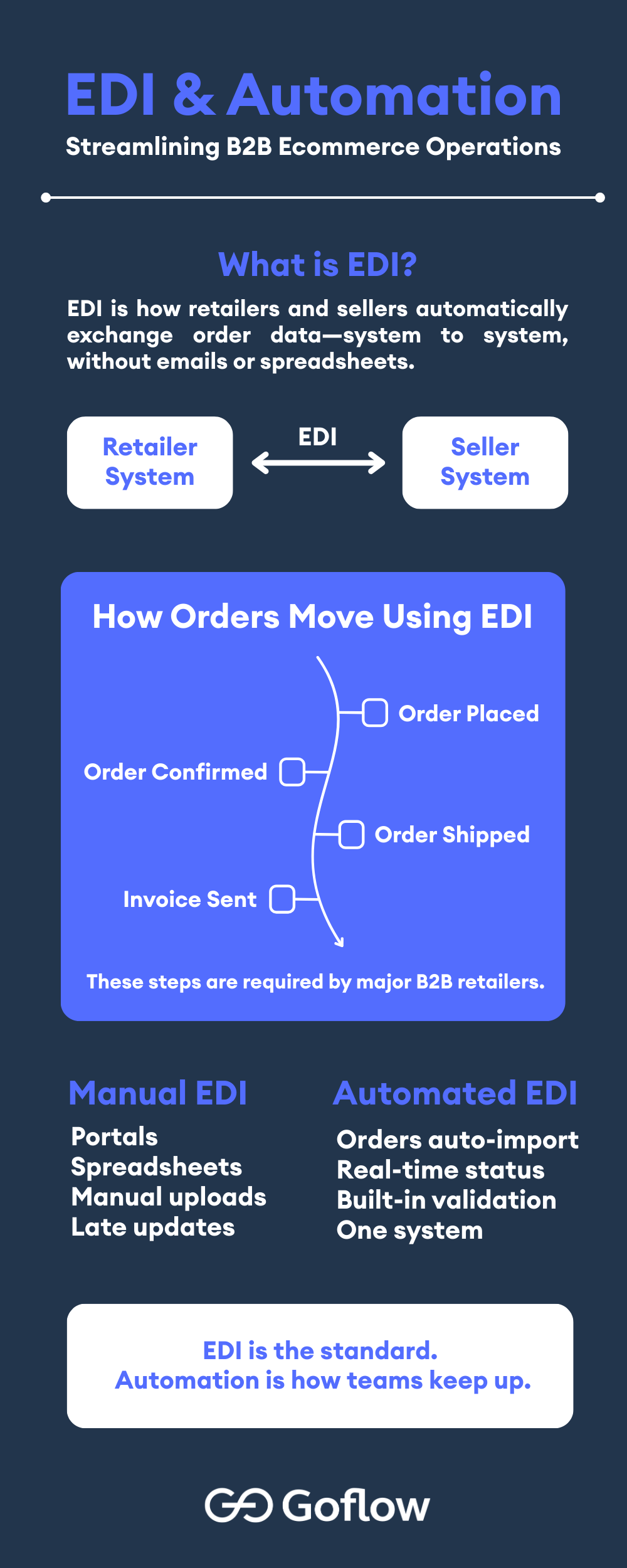
EDI (Electronic Data Interchange) is the electronic exchange of structured, standardized business documents between systems, without manual input.
Traditionally, these documents were sent on paper or verbally confirmed: purchase orders, invoices, advance ship notices, and routing requests. With EDI, they move system to system.
EDI isn’t “technology” in the consumer sense—it’s a protocol. A shared format that allows two parties to speak the same operational language.
In short, EDI is the transfer of structured data, using agreed message standards, from one computer system to another without human intervention.
Here’s how EDI actually moves an order from placement to payment.
A Quick History of EDI: Why It Was Invented
EDI was originally developed in 1948 to support logistics operations during the Berlin Airlift.
Over 2.3 million tons of food, fuel, and critical supplies were moved over 15 months. The challenge: every participant used different document formats, with no shared operational language. Tracking payloads via radio teletype and telex required standardization.
The Allied Forces needed a consistent way to communicate cargo manifests, delivery sequencing, aircraft loading data, and routing—without ambiguity.
EDI solved this problem.
That foundational work, led by Edward A. Guilbert, later became the basis for U.S. Transportation Data Coordinating Committee standards—the precursor to commercial EDI.
By the 1970s, manual transmissions (fax, phone calls, keyed spreadsheets) shifted to digitized EDI message sets. The result: fewer errors and shared structure across retailers, suppliers, and carriers.
EDI Still Powers Modern Commerce
Despite its age, EDI remains central to how modern ecommerce operates.
The global EDI software market is estimated at $2.60 billion USD and projected to grow to $4.54 billion by 2030—an ~11.8% CAGR.
Other research estimates a 2024 market size of $2.08 billion, growing to $5.3 billion by 2032. 86% of companies report using EDI to meet retailer or trading-partner compliance requirements.
Walmart, Amazon, Target, Costco, and other major retail ecosystems mandate EDI for PO intake, routing, and ASN/label compliance. Adoption continues to grow across retail, manufacturing, ecommerce, and logistics. North America leads in adoption, while Europe is the fastest-growing region.
EDI isn’t fading. Investment is expanding. It’s not legacy infrastructure—it’s still the rails modern retail runs on.
The Benefits of Electronic Data Interchange
EDI is the operational backbone that keeps retailers, warehouses, carriers, and inventory systems speaking the same language at speed.
When every trading partner has different PO formats, routing rules, label requirements, or ASN timing, EDI removes interpretation risk. It standardizes how information moves so teams don’t have to translate, re-key, or manually reconcile data.
Key advantages of EDI:
A shared document format—nothing lost in translation
Retailer rules, labels, routing, and formatting followed automatically
Documents move system to system, not file to file
Less manual work, fewer mistakes, fewer chargebacks
Faster pick-to-ship cycles and clearer delivery timelines
Secure, structured, encrypted data exchange
Once order volume scales—marketplaces, big-box retail onboarding, 3PL expansion—this shared language stops being optional and becomes essential to high-velocity fulfillment.
What Happens When EDI Breaks (or Isn’t Automated)
When EDI isn’t automated, validated, or monitored, it doesn’t just slow teams down—it destabilizes fulfillment.
Every document becomes a failure point: a late PO import, an ASN missing carton IDs, an invoice that doesn’t match shipped quantities. Operations shift from managing flow to putting out fires.
Common outcomes:
Retailer chargebacks
Late shipments
Incorrect ASNs
Scorecard penalties
Lost shelf space
These issues usually occur in the handoffs between PO → ASN → Invoice. Without validation and exception handling, teams fall into manual reconciliation—spreadsheets, portals, resends, and reactive fixes.
Compliance stops being paperwork and starts affecting profitability.
How Goflow Modernizes EDI
EDI remains the rails that ecommerce runs on. Software like Goflow doesn’t rewrite those rails—it automates how you ride them. Rather than replacing EDI, Goflow builds a modern, unified layer on top of it.
The more you scale, the more necessary this real-time visibility and control becomes.
We break this down further in our post on why serious ecommerce brands need a multichannel operating system to scale.
Some of the features and capabilities of Goflow that help you automate EDI include:
Inventory sent via EDI 846 documents: Goflow periodically sends these documents to keep your stores informed of available inventory.
EDI 850 POs constantly imported: Goflow checks the EDI integration endpoint for new 850 documents and transparently imports them as standard orders.
Confirmation via EDI 855 documents: Goflow automatically confirms POs at the retailer.
Bulk order confirmation: View all EDI orders in one place and confirm them in bulk.
EDI 753 Shipment Routing: Request shipment routing directly in Goflow for Amazon Vendor Central or Walmart Vendor, with freight fields pre-populated from your catalog.
EDI 856 Advance Shipment Notification (ASN): Goflow automatically sends ASNs as shipments leave the warehouse, complete with tracking information.
To learn more about how Goflow automates EDI across retailers, marketplaces, and warehouses, explore our EDI capabilities here.
Example: From Fragmented to Controlled
Imagine you’re a growing seller of home storage products—bins, collapsible racks, under-bed organizers—selling through Target+, Walmart, Amazon, and specialty retailers. Each partner has its own EDI rules, portals, and timing requirements.
Before Goflow:
Your operations lead jumps between portals, uploads corrections, and double-checks labels. Spreadsheets don’t match retailer dashboards. ASNs usually go out—just late enough to trigger warnings and occasional chargebacks. Nothing is broken, but everything is fragmented and behind.
After Goflow:
Every message flows through a single system. ASNs, invoices, and acknowledgments are sent automatically with real-time status tracking. When Target+ updates labeling rules, the change flows through instantly. No toggling. No reconciliations. No compliance panic.
One timeline. Clean execution. Calm operations.
Modernize EDI With Goflow
EDI isn’t slowing you down—fragmented, manual EDI workflows are.
The standard still underpins global retail. What breaks teams is juggling portals, rescuing late ASNs, and reconciling mismatched files.
Goflow adds the automation layer that EDI has been missing. Documents are validated before they go out. Exceptions surface early. Compliance becomes predictable instead of reactive.
If your team spends more time untangling ASNs, invoices, and routing rules than moving product, it’s not EDI that’s broken—it’s the workflow around it.
To see how this works in practice, explore Goflow Core for free—the unified operating layer that automates EDI, orders, inventory, and fulfillment in one system.
Or schedule a demo to see your order flow as it should run: unified, validated, and free of manual firefighting.