
Peak Season Surcharges in 2026: Which Orders They Hit Hardest and How Multichannel Sellers Protect Margin
.png)
Peak season surcharges are temporary per-package fees that carriers add on top of normal shipping rates while holiday volume is highest. For 2026, FedEx, UPS, and USPS all have them in place, and the most expensive stretch lands right on Black Friday week. The fees look small on a rate sheet. They don't land evenly across your orders, though, and that's where holiday margin quietly disappears.
The volume is coming either way. Adobe forecasts that U.S. online holiday spending will reach $275.1 billion between November 1 and December 31, 2026, up 6.7% from last year, with $47.5 billion of that landing during Cyber Week alone. Every one of those orders ships during the window when peak season surcharges are at their highest.
What peak season surcharges cost in 2026, and when they apply
All three major carriers run their peak season surcharges in phases. A lower rate kicks in during the fall, the highest rate covers the five weeks from Thanksgiving week through Christmas, and a lower rate returns until mid-January. Here's what a standard shipper pays per package for the two charges most multichannel sellers run into: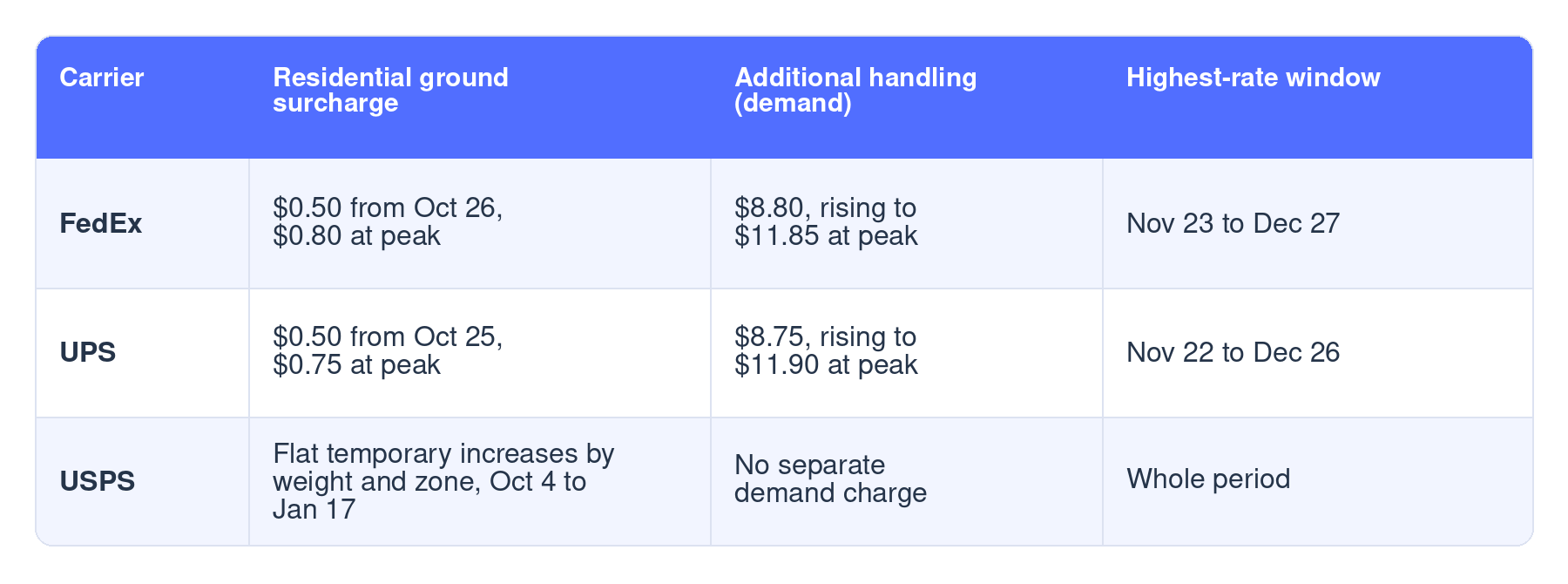 Sources: FedEx and UPS 2026 demand surcharge schedules; USPS 2026 holiday price change release. Standard shipper rates; high-volume shippers pay more.
Those numbers come straight from the FedEx demand surcharge schedule and the UPS demand surcharge schedule. On the USPS side, commercial Ground Advantage rises between $0.40 and $3.15 per package in Zones 1-4 and between $0.55 and $7.70 in Zones 5-9, depending on weight.
Which orders peak season surcharges hurt most
A flat fee is a percentage problem. The same $0.75 means almost nothing on one order and wipes out a big chunk of profit on another. Four types of orders tend to take the hardest hit.
Low-ticket orders with thin margins
Picture a $14 accessory that clears $3 in profit after marketplace fees. A $0.75 residential surcharge takes 25% of that profit before anything else goes wrong. Put the same surcharge on a $90 order and it's a rounding error. Sellers with a long tail of cheap add-on SKUs feel peak season surcharges first.
Oversized and awkward-to-pack SKUs
Anything that triggers additional handling or oversize fees gets a demand charge layered on top of the standard fee. At peak, UPS adds $11.90 per additional-handling package and $117.50 per large package. That one large package carries the same peak surcharge as about 150 residential ground orders at $0.75 each.
Orders upgraded to faster services late in the season
Express and 2-day services carry their own demand surcharges, and FedEx's 2Day charge more than doubles at peak, from $1.20 to $2.35. When a December order slips a day and gets bumped to a faster service to hit its promised date, it picks up both the pricier service and the pricier surcharge.
Sellers whose volume spikes far above normal
FedEx and UPS both charge high-volume shippers more based on how far weekly volume climbs above their baseline. For shippers moving more than 20,000 packages a week, the charge can reach $8.00 per package once volume tops 400% of baseline. A brand that runs a huge Black Friday push can end up in a far more expensive tier than its everyday numbers suggest.
How multichannel sellers protect margin from peak season surcharges
You can't negotiate peak season surcharges away this late in the year. What you can control is which carrier, service, box, and warehouse each order goes through. That's where most of the savings live.
Rate shop every order, not once a year
Carrier surcharges don't move in lockstep. UPS's peak window starts a day earlier than FedEx's and ends a day earlier, and USPS builds its holiday increase into its rates instead of adding a separate residential surcharge. Comparing rates order by order captures those gaps automatically. Goflow's rate shopping compares every enabled carrier and service, picks the cheapest one that still meets the delivery date, and re-checks open orders nightly as delivery windows shrink.
Fix packaging on your worst offenders now
Pull a list of SKUs that triggered additional handling or oversize fees last quarter. A slightly smaller box or a different pack-out can drop a product below the threshold entirely, which saves the base fee and the peak season surcharges stacked on top of it. Do this in October, not in the middle of December.
Ship from the warehouse that keeps orders in cheaper zones
USPS's temporary increases climb with distance, and so do base rates everywhere else. Sending an order from the warehouse closest to the customer keeps it in a cheaper zone. If you run inventory in more than one location, a solid multi-warehouse routing setup pays off most during exactly these weeks.
Price and promote with the surcharge in the math
Before you set free-shipping thresholds or Cyber Week discounts, run the numbers with peak rates included. Raising a free-shipping minimum by a few dollars or bundling a low-ticket SKU with a second item can turn a money-losing order back into a profitable one.
Why peak season surcharges are a multichannel problem
Every channel ships differently. Amazon, Walmart, Shopify, and TikTok Shop each come with their own delivery promises, shipping templates, and customer expectations, so the same SKU can carry a different shipping cost depending on where it's sold. When each channel's shipping rules live in a separate tool, nobody sees the full surcharge bill until the carrier invoice arrives in January.
That's the real risk here. Peak season surcharges rarely ruin a holiday season in one dramatic moment. They erode margin order by order, across channels, in ways a spreadsheet won't catch in time. Seeing shipping cost when the label is bought, not weeks later, is what lets you react while the season is still running. If you're still pressure-testing the rest of your operation, our peak season readiness guide covers the other four checks worth running before Thanksgiving.
Frequently asked questions about peak season surcharges
Q: When do peak season surcharges start and end in 2026?USPS temporary holiday rates run from October 4, 2026 through January 17, 2027. UPS residential demand surcharges start October 25 and FedEx's start October 26. Both carriers charge their highest rates from Thanksgiving week through Christmas, then drop back until mid-January. Q: Do peak season surcharges apply to every package?No. Residential ground surcharges apply to home deliveries, and separate demand charges hit packages that need additional handling or exceed size limits. Express and 2-day services carry their own surcharges, which are higher than the ground charges. Q: How can multichannel sellers lower peak shipping costs without slowing delivery?Rate shop each order across carriers, ship from the warehouse closest to the customer, and fix packaging on SKUs that trigger handling fees. Automated rate shopping that respects each order's delivery date cuts cost without missing marketplace shipping deadlines. Q: Are peak season surcharges negotiable?Large shippers can sometimes negotiate surcharge terms in their carrier contracts, but those discussions usually happen well before peak. For most sellers in October, the practical levers are carrier choice, packaging, and warehouse selection. |
Goflow's shipping and logistics tools bring rate shopping, carrier accounts, and label buying for every channel into one place, so peak season surcharges show up on the order instead of on a January invoice. Book a demo to see what your holiday orders would cost with the cheapest on-time option picked automatically.