
Multi-Warehouse Order Routing Guide for Multichannel Sellers
.png)
A customer in Austin orders a lamp. The Texas warehouse has it in stock. So does the New Jersey warehouse. The order management system picks New Jersey anyway, because nobody ever built a multi-warehouse order routing rule for this exact situation. That single decision adds two shipping zones and a full day of transit, and it repeats every time the same gap in the logic gets hit again.
Multi-warehouse order routing is the layer of logic that decides which warehouse fulfills each order, and getting it wrong is one of the most expensive mistakes a growing multichannel operation can make, order after order, without anyone noticing until the shipping bill or the support queue makes it obvious. According to ShipBob's 2026 State of Ecommerce Fulfillment Report, 86% of ecommerce brands now sell on two or more sales channels, up 8 percentage points from 2025. Every new channel and every new warehouse multiplies the number of routing decisions a system has to make correctly, in real time, with no person reviewing each one.
This piece breaks down how multi-warehouse order routing actually works, the rule hierarchy that separates reliable routing from guesswork, what broken routing costs a mid-size multichannel seller, and how to audit your own setup before peak season exposes the gaps.
What Is Multi-Warehouse Order Routing?
Multi-warehouse order routing is the automated process that assigns each incoming order to a specific fulfillment location, based on inventory availability, shipping cost, delivery promise, and warehouse capacity. It runs at the moment an order is captured, before a single item is picked, and it determines which building actually ships the box.
U.S. ecommerce sales reached $1.2337 trillion in 2025, up 5.4% year over year, according to the U.S. Census Bureau. That kind of volume is exactly why routing stopped being a minor setting and became a core piece of operational infrastructure: every incremental warehouse a seller adds to keep pace with growth multiplies the number of fulfillment decisions the system has to get right.
Routing, allocation, and orchestration are not the same job
These three terms get used interchangeably, but they do different work. Routing decides where an order should ship from. Allocation reserves the specific inventory units against that order once the location is chosen. Orchestration manages everything else in the order's lifecycle: payment capture, backorder handling, shipment confirmation, and exception recovery when a location can't actually fulfill what routing assigned it. A system that only does one of these jobs well tends to fail at the other two eventually, usually during a high-volume week when the failure costs the most.
The 4-Gate Order Routing Control Model
Most multi-warehouse order routing failures trace back to a missing gate, not a missing feature. The 4-Gate Order Routing Control Model lays out the order in which a routing decision should actually get made, filtering and ranking eligible warehouses before an order is assigned to one.
Gate | What It Decides | Example Rule | What Happens If Skipped |
|---|---|---|---|
Gate 1: Eligibility | Which locations can even be considered | Exclude any warehouse with zero available, non-reserved stock or outside its carrier's delivery zone | Orders route to warehouses that cannot actually fulfill them, triggering cancellations |
Gate 2: Priority | Which order-type rules override default logic | Route retail EDI orders to the location with same-day pick capacity, regardless of cost | Missed retail compliance windows and chargebacks from trading partners |
Gate 3: Optimization | The single objective this order is scored against | Minimize shipping cost for standard orders, minimize transit days for expedited orders | Every order gets evaluated against the wrong success metric |
Gate 4: Fallback | What happens when the top-ranked location can't execute | Pass to the next-ranked warehouse, then a 3PL, then a manual review queue | Orders stall in a queue nobody is actively watching |
Sellers running this multi-warehouse order routing logic across 250+ connected channels and 280 million-plus packages fulfilled to date have proven the pattern at real scale: eligibility first, priority overrides second, a single optimization objective third, and a defined fallback chain last. Skip any gate and the ones after it inherit the failure.
What Broken Multi-Warehouse Order Routing Costs Multichannel Sellers
The clearest symptom of broken multi-warehouse order routing is a rising split-shipment rate, and split shipments are rarely cheap. Carrier costs alone have been climbing: UPS raised average shipping rates 5.9% in December 2025, and FedEx matched that increase in January 2026. Every split shipment now carries a second base rate, a second fuel surcharge, and often a second dimensional-weight penalty, on top of whatever the order was already going to cost to ship once.
Seller Case Study: A Home Goods Brand's Routing Fix
A home goods brand running 3,200 SKUs across four warehouses, two owned and two 3PL, was routing every order to the geographically closest location, full stop. No inventory check, no cost comparison, no fallback logic.
At roughly 60,000 monthly orders across Amazon, Walmart, and Shopify, about 14% of orders were splitting into two or more shipments because the closest warehouse rarely held the complete order in stock. Each split added an estimated $9 to $14 in duplicate parcel and handling costs, and support tickets tied to delayed second packages ran nearly triple the brand's average.
After adding a two-gate rule, inventory eligibility first and single-location fulfillment preference second, to its routing logic, the brand cut its split-shipment rate from 14% to under 4% within one quarter, recovering an estimated $340,000 a year in avoidable shipping and handling cost.
The Multi-Warehouse Order Routing Mistake Most Sellers Make
The fastest warehouse isn't the closest one.
Most sellers assume proximity-based routing is the safe default: ship from whichever warehouse sits nearest the customer's zip code. It feels intuitive, and it's the first rule most systems ship with.
The problem is that distance and carrier zone are not the same thing, and neither one accounts for what a warehouse can actually do right now. A location ten miles closer on a map can sit in a worse carrier zone, be short a critical SKU, or be running at full pick capacity during a promotion. Proximity-only routing optimizes for a number that, on its own, determines neither cost nor speed.
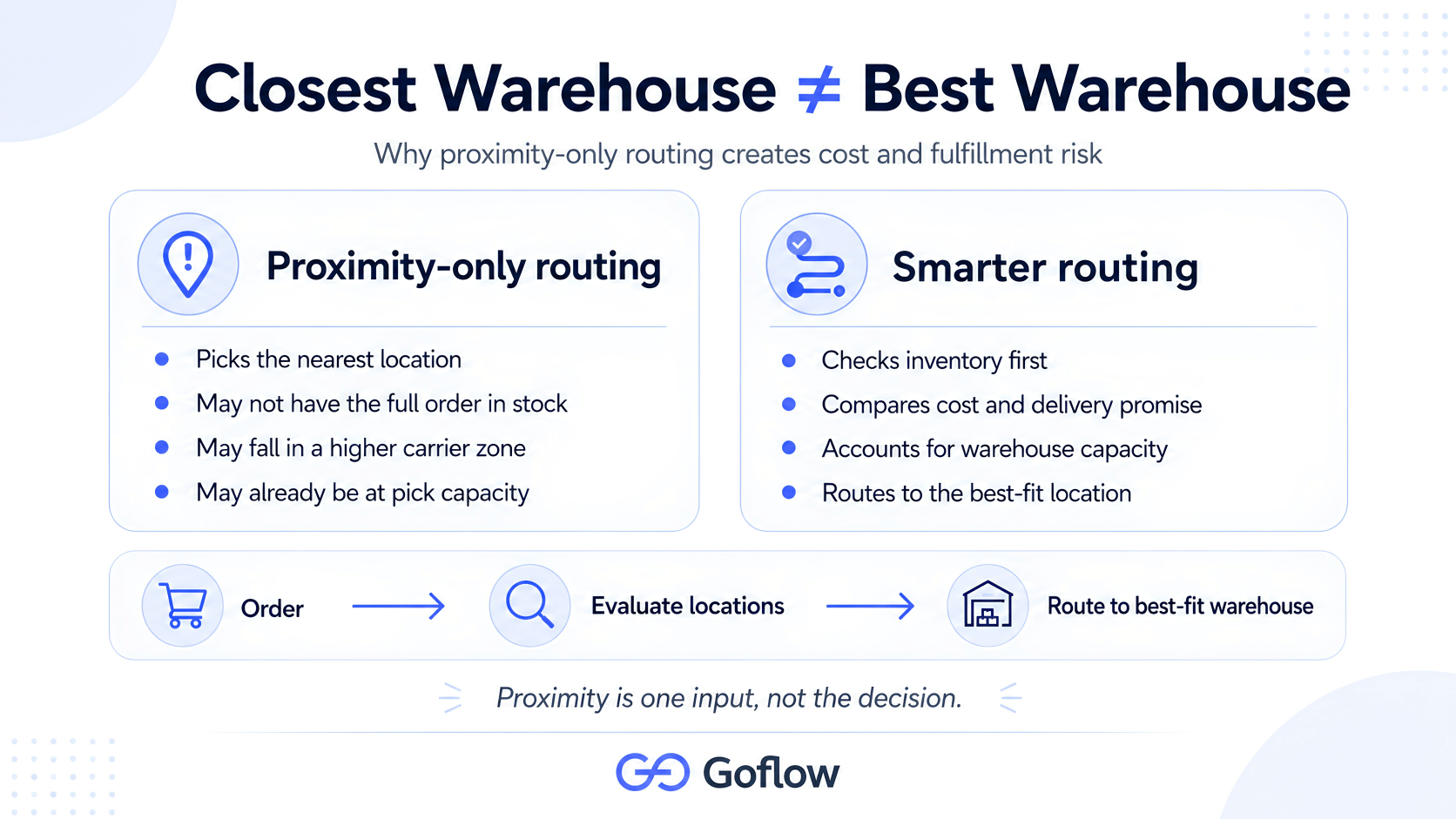 The correct mental model treats proximity as one input among several, not the deciding one. Inventory eligibility comes first. Zone-based shipping cost comes second. Proximity only breaks a tie between two locations that already passed both checks. With ShipBob reporting that 75% of brands plan to add at least one new sales channel in 2026, up 12 percentage points from 2025, the number of warehouses and routing decisions each seller manages keeps climbing, and proximity-only logic breaks faster as that count grows.
How to Audit Your Multi-Warehouse Order Routing
An honest audit of multi-warehouse order routing starts with three numbers most operations teams have never pulled together in one place: the split-shipment rate, the fallback failure rate, and how routing behaves the week a new channel goes live. Cost remains the top reason brands say they'd switch 3PLs, according to GoBolt's 2025 State of Logistics Report, but a fulfillment partner change rarely fixes a multi-warehouse order routing problem that actually lives in the order management system, not the warehouse.
Check the multi-warehouse order routing split-shipment rate
Pull the percentage of orders that shipped from more than one location over the last 90 days. Anything above 8 to 10% for a seller with genuine multi-location inventory usually points to a missing eligibility or single-location preference rule, not a real stock shortage.
Check what happens when the top-ranked warehouse can't fulfill
Place a test order for a SKU that's deliberately out of stock at the preferred location. If the order stalls instead of automatically passing to the next eligible warehouse, there is no functioning Gate 4 in the current multi-warehouse order routing setup, and every stockout at the primary node is quietly costing sales.
Check whether routing rules survive a channel launch
New channels bring new promise windows, new SLA requirements, and sometimes entirely new warehouses. Confirm that routing rules apply automatically to a new channel at launch rather than requiring a manual rebuild, since that gap is exactly where retail EDI compliance violations tend to originate.
What Happens to Multi-Warehouse Order Routing as Every Channel Expects Real-Time Fulfillment?
The AI layer arriving in routing decisions
eMarketer projects AI platforms will drive 1.5% of total U.S. retail ecommerce sales in 2026, roughly $20.57 billion, nearly four times the 2025 figure. As agentic shopping tools start placing orders directly, routing logic has to make correct decisions with even less human review in the loop than it does today, which raises the cost of any gap in the multichannel operating system behind it.
Retail EDI compliance keeps tightening
Trading partners that require EDI are getting stricter about ship-window compliance, not looser. Routing rules that treat retail EDI orders as a priority override, rather than folding them into the same default logic as marketplace orders, will matter more each year, not less.
Competitive differentiation moves from shipping to routing intelligence
Free and fast shipping is table stakes across every major channel now. The sellers who actually win on delivery experience are the ones whose routing logic makes the right call on the first try, not the ones simply adding more warehouses and hoping proximity sorts it out.
How Goflow Handles Multi-Warehouse Order Routing
Goflow's approach to multi-warehouse order routing evaluates inventory, shipping cost, delivery commitments, and warehouse capacity for every order in real time, then assigns it to a fulfillment location automatically instead of defaulting to whichever warehouse is closest or most familiar. Sellers configure the same gate logic described above directly inside Goflow's order fulfillment software, without custom code or a separate routing tool bolted onto the OMS.
Inventory eligibility checks pull from the same real-time ledger that powers Goflow's inventory management, so routing decisions never run on stale stock counts, which is the failure mode behind most split shipments. That same real-time foundation is what let BBG Surgical raise order accuracy from 85% to 98% while scaling to 75,000 monthly orders on Goflow, without adding warehouse headcount.
Because routing rules apply across every connected channel, from Amazon and Walmart to 1200+ marketplace and EDI integrations, sellers don't have to maintain a separate rule set per channel every time they expand. Sellers running two or more fulfillment locations who are still routing on proximity alone can book a demo to see how Goflow's routing rules apply across every warehouse and channel from day one.
Frequently Asked Questions About Multi-Warehouse Order Routing
Q: What is multi-warehouse order routing?
Multi-warehouse order routing is the automated logic that decides which fulfillment location ships each order, based on inventory availability, shipping cost, delivery promise, and warehouse capacity. It runs the moment an order is captured, before allocation or picking begins.
Q: How is multi-warehouse order routing different from inventory allocation?
Routing decides which warehouse should fulfill an order. Allocation reserves the specific inventory units at that warehouse once routing has made its choice. A system can route correctly and still fail if allocation doesn't lock the right units in real time.
Q: What typically causes split shipments in a multi-warehouse operation?
Split shipments happen when no single warehouse holds every item in an order, forcing the system to fulfill from two or more locations. Proximity-only routing, stale inventory counts, and missing single-location preference rules are the three most common causes.
Q: How many warehouses does a seller need before routing rules actually matter?
Routing complexity starts the moment a seller operates from two locations. With two warehouses, every order becomes a decision instead of a default, and that decision needs a documented rule hierarchy rather than a single closest-location setting.
Q: What's the best order management software for multi-warehouse routing?
The right fit depends on channel mix and order volume, but the strongest platforms combine real-time inventory visibility, configurable routing rules across cost and speed objectives, and automatic fallback when a preferred warehouse can't fulfill. Goflow builds all three into one system instead of requiring separate routing and inventory tools.
Q: What happens when the top-ranked warehouse can't fulfill an order?
A well-built routing system automatically passes the order to the next-eligible warehouse, then to a 3PL, then to a manual review queue if nothing qualifies. Without a defined fallback chain, those orders stall silently until someone happens to notice them.