
Marketplace SLA Compliance: Two Days to Ship or Delisted
.png)
Marketplace SLA compliance is the practice of meeting each sales channel's required dispatch, delivery, and service-metric windows closely enough to keep a seller account in good standing. TikTok Shop's own Fulfillment Policy sets that window at two business days: an order needs a carrier scan moving it to In Transit within 48 business hours of payment, or it counts against the seller's Late Dispatch Rate. Cross the threshold enough times and TikTok Shop can cap how many orders the shop is allowed to sell in a day.
A single missed scan rarely matters. A pattern of them does. Amazon, TikTok Shop, and eBay each run a different calculation on the same underlying data, asking how often this seller shipped late, canceled unexpectedly, or generated a complaint serious enough to count as a defect. A multichannel seller running the same SKUs across five or six of these channels is really running five or six separate clocks at once, each with its own tolerance for error.
What marketplace SLA compliance means for multichannel sellers
Marketplace SLA compliance means keeping every channel's dispatch, delivery, and defect metrics under the threshold that triggers a penalty, all at the same time, across every channel a seller operates on. A seller can meet Amazon's requirements perfectly and still lose visibility on TikTok Shop if the same warehouse process is graded against a different clock.
Per TikTok Shop's Fulfillment Policy, sellers are recommended to keep Late Dispatch Rate at or below 4%, and enforcement actions can follow once it passes 10%. The clock starts the moment payment clears, not when a warehouse gets around to picking the order, which is exactly where a lot of otherwise well-run operations lose the window without noticing.
For a single-channel seller, SLA compliance is one dashboard to watch. For a multichannel seller, it is a coordination problem: the same order-to-ship process has to satisfy several different definitions of on time, at once, without slowing down for any one of them.
 The 3-Layer Marketplace SLA Risk Model
The 3-Layer Marketplace SLA Risk Model breaks marketplace SLA compliance into three signals that every major channel measures in some form: dispatch speed, order accuracy, and delivery consistency. A seller can pass two of the three layers and still trigger enforcement if the third slips, because marketplaces score each layer on its own rather than averaging them together.
Layer | What it measures | Marketplace equivalent | Failure mode |
|---|---|---|---|
Layer 1: Dispatch speed | Time from payment to carrier scan | Amazon Late Shipment Rate, TikTok Shop Late Dispatch Rate, eBay late shipment rate | A backlog at the packing station shows up as an account health drop within days, not weeks |
Layer 2: Order accuracy | Rate of negative feedback, claims, and chargebacks | Amazon Order Defect Rate, eBay transaction defect rate | One unresolved dispute can outweigh weeks of on-time shipping in the same rolling window |
Layer 3: Delivery consistency | Whether tracking and delivery match what the buyer was promised | Amazon On-Time Delivery Rate, TikTok Shop On-Time Delivery Rate | A carrier delay outside a seller's control still counts against the account unless it is documented and appealed |
The 3-Layer Marketplace SLA Risk Model: each layer is scored separately by every major marketplace, so strength in one does not offset weakness in another.
How Amazon, TikTok Shop, and eBay enforce different SLA windows
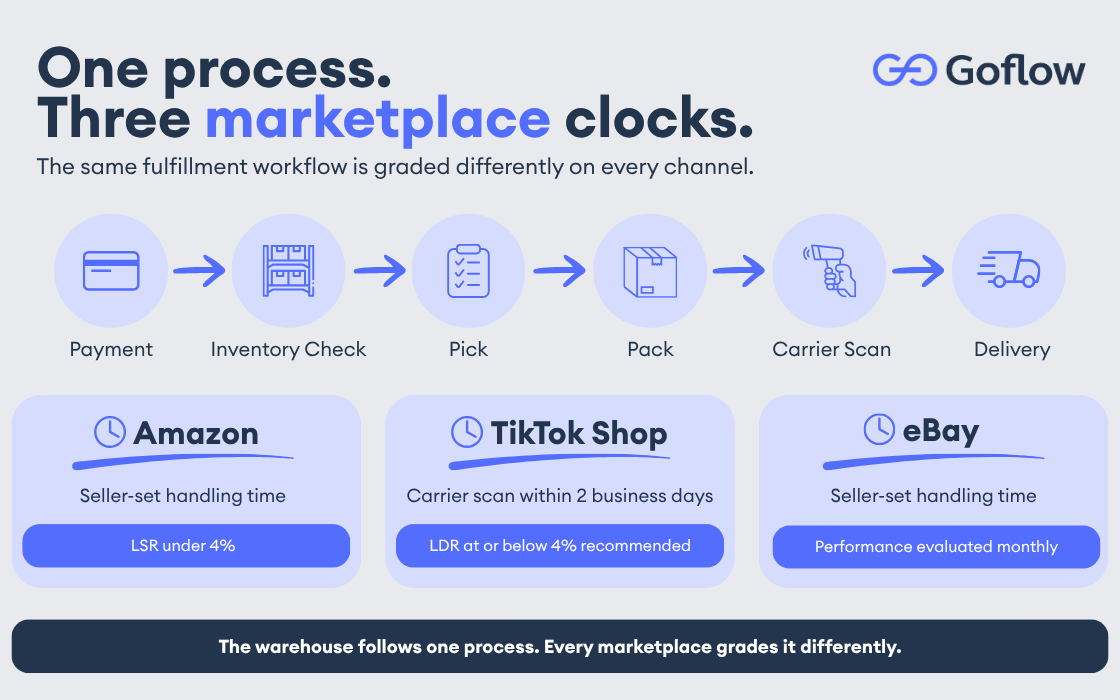
Amazon, TikTok Shop, and eBay all measure shipping speed, but none of them share a window, threshold, or grace period, which is exactly why one fulfillment process can pass marketplace SLA compliance on one channel and fail it on another. Amazon requires sellers to keep Late Shipment Rate under 4% and Order Defect Rate under 1%, both calculated over rolling windows rather than a fixed monthly cycle.
Marketplace | Dispatch window | Key threshold | Escalation |
|---|---|---|---|
Amazon | Seller-set handling time, LSR measured over 10 and 30 days | LSR under 4%, ODR under 1% | Buy Box loss, then account deactivation |
TikTok Shop | 2 business days from Awaiting Shipment to carrier scan | LDR recommended at or below 4% | Enforcement actions above 10%, tiered order volume limits |
eBay | Seller-set handling time, evaluated monthly against late shipment rate | Seller level shifts from Above Standard toward Below Standard as late shipment rate rises | Reduced listing visibility, loss of Top Rated badge |
SLA enforcement varies enough across marketplaces that a fulfillment process built for one channel's window can fail another channel's without any change in warehouse performance.
TikTok Shop's 2026 formula update closed a specific loophole: it now counts orders still sitting unshipped past the dispatch deadline the same way it counts orders that shipped late, according to TikTok Shop's own Late Dispatch Rate documentation. Letting an order sit rather than confirming a late shipment no longer helps a seller's numbers.
What an SLA violation costs before an account ever gets flagged
An SLA violation costs a multichannel seller long before a suspension notice arrives, because the same metrics that trigger enforcement also govern Buy Box eligibility, search ranking, and ad approval. A seller can still be technically selling while losing most of the visibility that actually drives revenue.
Real Goflow customer: BBG Surgical
BBG Surgical, a medical and surgical products distributor selling across multiple channels, scaled to roughly 75,000 monthly orders while its inventory and order data stayed disconnected across separate systems.
After moving order processing and inventory visibility onto Goflow's unified platform, BBG Surgical improved order accuracy from 85% to 98%, according to Goflow's published case study. Order accuracy sits directly inside Layer 2 of the SLA Risk Model above, and a jump from 85% to 98% is the difference between an Order Defect Rate that risks suspension and one that comfortably clears every marketplace's threshold.
The SLA mistake most multichannel sellers are about to make
Most sellers respond to an SLA warning by hiring more packing staff or switching carriers. That fixes the symptom in whichever layer just tripped and does nothing for the other two, because the underlying problem usually is not speed at all.
The contrarian claim: SLA violations are an inventory visibility problem wearing a shipping costume
The common assumption is that a late dispatch warning means a seller needs to pack faster or add another shift.That misreads what usually causes the spike. A sudden run of late shipments, cancellations, or delivery misses is most often the downstream effect of inventory or order data that fell out of sync somewhere upstream, a stockout the warehouse did not know about yet, an order that hit two systems at different times, a SKU mapping that broke after a catalog update.
Global retail ecommerce is projected to reach $5.7 trillion in 2026, with marketplaces accounting for 67% of that total, according to Digital Commerce 360 and eMarketer. At that scale, a seller running five or six marketplace connections on manually reconciled spreadsheets is not one bad week away from an SLA problem. They are already inside one and have not been flagged yet.
How to audit your multichannel operation for SLA risk
An SLA risk audit starts by checking whether the same order shows the same status in every system that touches it at the same moment, not by timing how fast the warehouse can move.
Check the gap between order receipt and system visibility
Pull a sample of orders from each channel and compare the marketplace's order timestamp against the moment that order became visible in the warehouse's picking queue. Any gap measured in hours, not minutes, is time being quietly subtracted from the dispatch window before a single item gets picked.
Check inventory sync latency across every channel
Real-time sync means a stock change on one channel reflects everywhere else within minutes. Goflow's platform has processed more than 629 million transactions across its multichannel sellers, a volume that only holds up on minute-by-minute synchronization, not overnight batch updates. Confirming this is a matter of comparing the timestamp on an inventory change against when every other channel reflects it.
Check carrier scan confirmation, not just label creation
Printing a shipping label is not dispatch confirmation on TikTok Shop or Amazon. Both require the carrier's own scan event before the order counts as shipped, and a label that never gets scanned still counts as late. A weekly reconciliation between labels printed and carrier scans received catches this gap before it shows up on an account health dashboard.
What happens as marketplaces keep tightening SLA windows
SLA windows are getting shorter, not longer, as marketplaces compete on delivery speed, and a multichannel seller's fulfillment infrastructure will decide who absorbs that pressure and who gets throttled out of visibility first.
Automation is becoming the entry price, not the advantage
A manual pick-and-pack process that cleared a 4 or 5 day dispatch window comfortably has almost no slack against a 2 business day requirement. What used to be a competitive edge, automated order routing and real-time inventory sync, is turning into the minimum needed to stay listed at all.
Attribution gets harder to defend without single-view reporting
When an SLA violation happens on one channel, the seller needs to show, quickly, whether the cause was internal or a carrier failure outside their control. Sellers piecing that answer together from five separate marketplace dashboards lose the appeal window before they even finish gathering evidence. Sellers with one consolidated view do not.
Marketplace consolidation raises the stakes of any one account
Walmart Marketplace grew 32% year over year and now counts more than 150,000 third-party sellers, according to Walmart's own investor relations disclosures. As more sellers concentrate onto fewer major channels, losing SLA compliance on any single one removes a larger share of total reach than it would have a few years ago.
Sellers who unify data first will not be the ones scrambling
The gap between a seller who treats marketplace SLA compliance as one connected system and a seller who treats it as five separate dashboards is going to widen, not narrow. The first group adjusts once when a threshold tightens. The second group re-fights the same fire drill on every channel, every time a policy changes.
How Goflow keeps multichannel operations inside every marketplace's SLA window
Marketplace SLA compliance is a byproduct of the same unification Goflow was built for. Four connected systems keep the data that Amazon, TikTok Shop, and eBay all check in sync:
Order management routes orders into the picking queue the moment they arrive, closing the gap between order receipt and warehouse visibility that eats into every channel's dispatch window
Inventory management keeps stock levels synced in real time across every channel, so a stockout on one marketplace does not turn into a cancellation-driven defect on another
Shipping and logistics confirms carrier scans against every marketplace's dispatch requirement automatically, instead of relying on a manual label-versus-scan reconciliation
Reports and analytics consolidate performance data across every channel into one view, so a seller can document the root cause of an SLA violation and file an appeal before the window closes
Sellers already running real-time inventory sync across Amazon, Walmart, and Shopify are already ahead of most of the layers this framework covers, since inventory accuracy and dispatch speed draw from the same underlying data. Every serious multichannel brand is one SLA window away from finding out whether its operations can handle the next threshold change. Book a demo to see what marketplace SLA compliance looks like when every channel pulls from the same synced data.
Frequently asked questions about marketplace SLA compliance
Q: What is marketplace SLA compliance?Marketplace SLA compliance means meeting the dispatch, delivery, and defect-rate thresholds each sales channel requires to keep a seller account in good standing. Amazon, TikTok Shop, and eBay each set their own windows and thresholds, so a seller has to satisfy several definitions of on time at once. Q: What happens if a seller misses Amazon's Late Shipment Rate threshold?Amazon requires sellers to keep Late Shipment Rate under 4%. Crossing that threshold can cost Buy Box eligibility first, followed by reduced search visibility, and repeated or severe violations can lead to account deactivation. Q: How is TikTok Shop's Late Dispatch Rate calculated?TikTok Shop's 2026 formula divides orders dispatched late plus orders canceled due to late dispatch by the total seller-fulfilled orders paid in a 7-day window. Orders left unshipped past the 2-business-day deadline count against the rate even if they are never formally shipped late. Q: Can a seller appeal an SLA violation caused by a carrier delay?Most marketplaces allow appeals when a carrier, not the seller, caused the delay, but they require documented proof such as a carrier scan record filed within a limited window, often 30 days. Sellers without consolidated reporting across channels often miss that window while gathering evidence. Q: How can multichannel sellers monitor SLA compliance across every channel at once?Multichannel sellers keep SLA compliance in view by consolidating order status, inventory sync timing, and carrier scan confirmation into one dashboard instead of checking each marketplace's seller portal separately. That single view is what lets a seller catch a slipping metric before it crosses a marketplace's threshold. Q: What is the difference between Amazon's Order Defect Rate and Late Shipment Rate?Order Defect Rate measures negative feedback, A-to-z claims, and chargebacks over a rolling 60-day period and must stay under 1%. Late Shipment Rate measures how often seller-fulfilled orders ship after their expected ship date over 10 and 30-day windows and must stay under 4%. They are scored independently, so a seller can pass one and still fail the other. |