
How to Choose the Right Multichannel Operating System for Your Ecommerce Business in 2026
.png)
How to Choose the Right Multichannel Operating System for Your Ecommerce Business in 2026
You know you need better control over your channels, inventory, and fulfillment, but you’re not sure which tool will help you achieve that. Every tool promises to solve your problems, but how do you know which system will actually meet your needs?
Choosing the right multichannel operating system for your ecommerce business means looking for a platform that will work with your operations, scale with you, and enforce control, rather than creating more manual work for you.
Before evaluating any platform, it helps to get clear on what a true multichannel operating system should actually centralize.
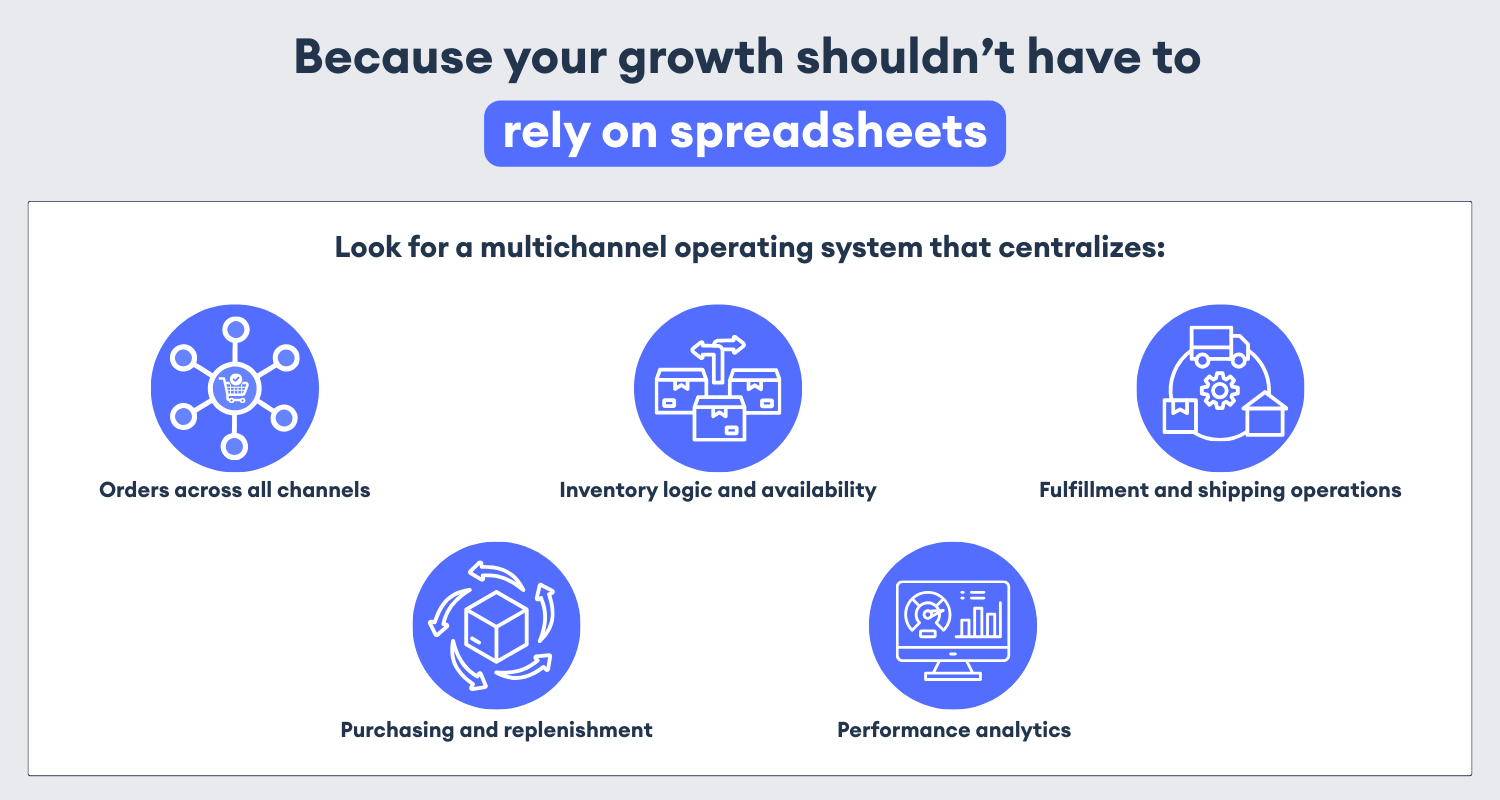 If a system can’t centralize these workflows, it won’t give you real operational control, no matter how many features it offers. That’s when spreadsheets enter the picture.
They often become the glue between disconnected tools, filling gaps in inventory logic, order routing, and replenishment decisions. That works for a while, but as volume and channels grow, spreadsheets turn into a source of delay, errors, and manual work. A true multichannel operating system removes the need to patch systems together by centralizing control in one place.
In this post, we’ll offer helpful, step-by-step guidance on how to evaluate the right system, what operational features really matter, and how to avoid common pitfalls when choosing a multichannel operating system in 2026.
9 Steps to Choosing the Right Multichannel Operating System
Step 1: Get Clear on How Your Operations Actually Work
Your process should always lead, and the software you choose should follow. Therefore, the first step in choosing the right software is to define your process and map your current workflows, including inventory, fulfillment, order routing, and returns.
As you do this, keep an eye out for recurring pain points or manual workarounds that are slowing down your operations. Ask yourself: where do errors, delays, or oversells happen most? For example, if you find that your team is constantly reconciling stock between Shopify and Amazon, you’ll probably decide automation is a non-negotiable feature in a solution.
As you map these workflows, pay attention to whether orders, inventory availability, fulfillment decisions, and replenishment are managed in one system or scattered across tools.
Step 2: Decide What The System Must Do (and What You Won’t Compromise On)
The next step is to identify the most important features that your multichannel operating system needs to have. This will depend on the specific needs of your business, but some of the most useful features ecommerce operators often look for include:
Centralized inventory logic across all channels.
Automated reconciliation and rule enforcement.
Real-time syncing and predictive analytics.
Alerts for exceptions and bottlenecks.
Make a list of the features that are crucial for your operations, as well as the ones that would be “nice to have” if possible.
These requirements should directly support the core workflows your operating system needs to centralize, not sit alongside them as add-ons.
Step 3: Make Sure It Can Actually Handle Multichannel Complexity
Not all tools labeled “multichannel” are capable of handling the amount of complexity that your business may require. Look deeper into the system to make sure it can coordinate various rules across all sales channels and fulfillment partners.
Also, does the system you’re evaluating support complex scenarios such as split fulfillment, channel-specific buffers, and priority routing? This is another aspect to pay attention to when you’re choosing the right multichannel operating system for your ecommerce business, as you want the system to be able to handle these cases when they arise.
Step 4: Choose Automation Over Manual Decision-Making
Visibility alone isn’t control, and your system should act on predictable situations automatically. You only have to make a smart decision once, and then you can set things up so that those decisions are carried out every time, even when you’re asleep or sipping margaritas on the beach.
There are many different rules you can automate within the system that will offer you a competitive advantage, including:
Holding low-stock SKUs before oversells occur.
Prioritizing high-value orders during fulfillment constraints.
Routing inventory based on delivery SLAs or cost.
Step 5: Avoid Delayed Inventory Updates
One of the problems that ecommerce operators face when selling across multiple marketplaces like Amazon, Shopify, and Walmart is inventory sync delay. This is what happens when each channel has its own refresh rates, reservation logic, and API limitations, and they end up out of sync with each other.
For example, your Shopify orders might update every 5 minutes, but Amazon updates every 10 minutes. The mismatch might seem insignificant, but during high-traffic sales, it can cause discrepancies that could result in overselling.
To avoid this issue, it’s important to look for a system that syncs your inventory continuously and in real-time, so that you can rest assured that all discrepancies will be corrected automatically.
Step 6: Look Beyond Reporting to Prediction
It’s not about just observing what happens; it’s about being prepared for what will happen next. Using forecasting effectively gives you an edge, and the most effective ecommerce operators build predictive rules into the system so decisions happen automatically.
Look for a multichannel operating system that will allow you to forecast inventory pressure before stockouts happen, anticipate fulfillment bottlenecks, and model “what-if” scenarios across channels.
Take a look at our blog post for a deeper dive into how to use the power of inventory forecasting to your advantage: Inventory Forecasting Guide: How to Predict Demand.
Step 7: Make Sure It Fits Your Stack (and Your Reality)
Once you’ve started to narrow down your options, it’s also important to consider which system works best with everything else in your toolkit.
Here are some essential questions to ask at this stage:
Does the system integrate well with the marketplaces you sell on, as well as 3PLs, ERPs, and internal tools?
Does adding new channels or partners require heavy manual setup?
Will this system be able to scale with your operations without creating more manual work?
Step 8: Turn Data Into Early Warnings, Not Post-Mortems
When it comes to setting up your multichannel operating system, the key is to look ahead and anticipate problems, rather than only being able to analyze them after they occur. This is one of the huge advantages to implementing a multichannel operating system.
Using a dashboard or a spreadsheet might show you what already happened, but a predictive, automated system will spot issues before they arise and make smart adjustments to prevent them. Look for a system that allows you to set automatic alerts for low stock, sync errors, or fulfillment delays. The reports the system generates should be actionable, rather than just dashboards.
The ultimate goal is to give your team the chance to act before problems reach customers.
Step 9: Choose a Partner, Not Just a Platform
When you choose a multichannel operating system, you’re choosing not just the software itself, but also the team behind the software who make it work and support the users. That’s why it’s important to look for ongoing support, training, and feature updates, which will improve your experience in the long run.
Ask yourself, “Does this platform really understand multichannel complexity?” It’s worth taking a look at the onboarding process and the documentation, as they will give you an indication of the level of support and will affect long-term adoption and ROI.
The Right Multichannel Operating System Will Set You Up For Ecommerce Success
Selecting the right multichannel operating system for your business is about more than just shiny features, it’s about finding operational maturity with a system that can handle all the complex scenarios modern ecommerce sellers face.
The key questions to ask yourself when choosing include:
Does the system centralize inventory and enforce rules automatically?
Can it scale with your sales volume and channel complexity?
Does it offer core fulfillment features such as real-time, unified inventory and order management, intelligent automation, shipping management, and returns processing?
Will it proactively prevent oversells and bottlenecks instead of relying on dashboards?
Finding the right system for your business takes a bit of research and trial and error, but it’s worth taking the time to get it right. When you find the right system, it will turn complexity into calm, reduce firefighting, and let you scale confidently.
Want to see what a system built for real operational control looks like? Book a Goflow demo and see it in action.
Ready to get started? Sign up for Goflow Core for free.